
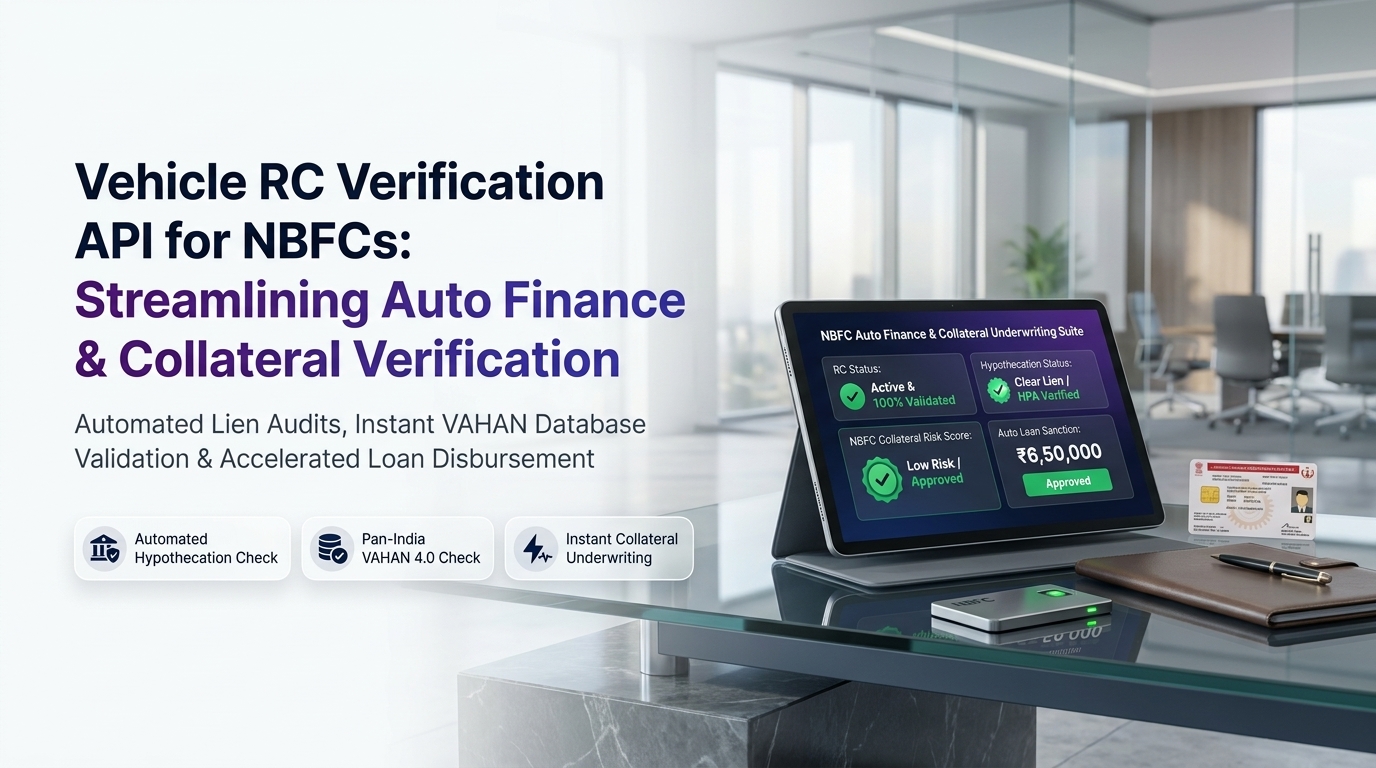
Vehicle RC Verification API for NBFCs: Streamlining Auto Finance & Collateral Verification
The credit head of a small NBFC in Rajasthan once told me his real underwriting problem wasn't borrowers. It was one dealer.
His company finances used tractors and commercial vehicles across tier-2 towns, and like most NBFCs that size, the loan files come through dealer partners. Good dealers send good files. This particular dealer sent excellent files, complete, neat, photographed from flattering angles, and it took the NBFC fourteen months to notice that three of those files, at different branches, were secured by the same Mahindra pickup. Same vehicle, three loans, three sets of photographs taken on three different days with three different borrowers standing next to it. The dealer collected his commission on all three. Two of the borrowers, it later emerged, didn't know they were borrowers.
Branch staff had "verified" the vehicle each time. Physically. The vehicle existed, that was never the issue. What nobody did was pull the registration record, where the first lender's hypothecation entry had been sitting since month one, and where the registered owner's name matched none of the three applicants. Fourteen months of a check that a vehicle RC verification call performs in two seconds.
Why NBFCs get hit hardest
Banks get defrauded too, but the NBFC operating model has particular soft spots, and I say this with affection for the segment I've worked in for years. Files arrive through dealers and agents, which inserts a commercial interest between the lender and the truth. Branches run lean, one credit person wearing four hats, so "verification" becomes whatever fits between other work. The customer base skews toward first-time borrowers with thin files, so the vehicle is often the entire security. And ticket sizes are small enough that a proper investigation per file never made economic sense.
Which is exactly why the segment moves to APIs. A vehicle verification API for NBFCs doesn't ask branch staff to become forensic examiners. It puts the registration record, registered owner, maker and model, registration date, fitness validity, hypothecation entry, into the file automatically at login, and it costs a few rupees. The economics that made verification unaffordable now make it unavoidable.
Vehicle RC verification for collateral verification
Here's what vehicle RC verification for collateral verification actually screens, in the order it saves NBFCs money.
The hypothecation entry first, always first. If another financier's charge is on the record, you are not the first lender, whatever the file says, and the Mahindra pickup case is what skipping this looks like. Second, vehicle ownership verification, the registered name against the applicant's identity. In the pickup fraud, this alone would have failed all three files. A mismatch isn't always fraud, tractors especially get registered under a father's name while the son farms and borrows, but it's always a question worth one phone call before disbursal. Third, the vehicle's actual identity and age: the record's make, model, and registration date against the valuation report, because a 2012 vehicle presented as a 2017 one quietly destroys your loan-to-value assumption. Fourth, fitness validity on commercial vehicles, since a vehicle that can't legally run can't earn its EMI.
After the pickup episode, the Rajasthan NBFC wired a vehicle ownership verification API into loan login, every file, no exceptions, dealer-sourced or direct. In the first quarter it flagged mismatches on about nine percent of files. Most were innocent, the father's-name pattern, mostly. Three were the same dealer trying again. He's no longer a partner, and the NBFC's write-offs on vehicle loans fell by a number the credit head declines to publish but describes as "the best argument I ever took to my board."
What to look for in the API
Selecting a vehicle RC verification API for auto finance is the same discipline we laid out for fintech lenders and in the banking post, with two NBFC-specific additions. Branch usability matters more, the check has to run from a phone at a dealership counter, not just inside a head-office system. And batch capability matters for the back book: the real first project at most NBFCs isn't new files, it's running the existing portfolio through the API and discovering what fourteen-month surprises are already sitting in it. Beyond that, the standards are unchanged: distinct response states rather than pass-fail, consent captured, every response timestamped and logged per our API security guide. Sector context, if you want it, lives with the industry body FIDC, which represents NBFCs and publishes regularly on the segment's growth.
The best vehicle RC verification API for NBFCs is the one your most junior branch employee uses correctly on a busy Saturday, returns the record in seconds, and leaves a log your auditor accepts without a meeting.
Conclusion
The Mahindra pickup is still running, presumably profitably, for whoever actually owns it. The NBFC that financed it three times now checks every record at login and sleeps better. That's the whole case for a Vehicle RC Verification API for NBFCs in one sentence: your collateral is only as real as its registration record, and the record costs a few rupees to read. Check the charge, match the owner, confirm the vehicle, log the response. The dealers stay honest when they know you're looking, and the ones who don't stop being your problem.