
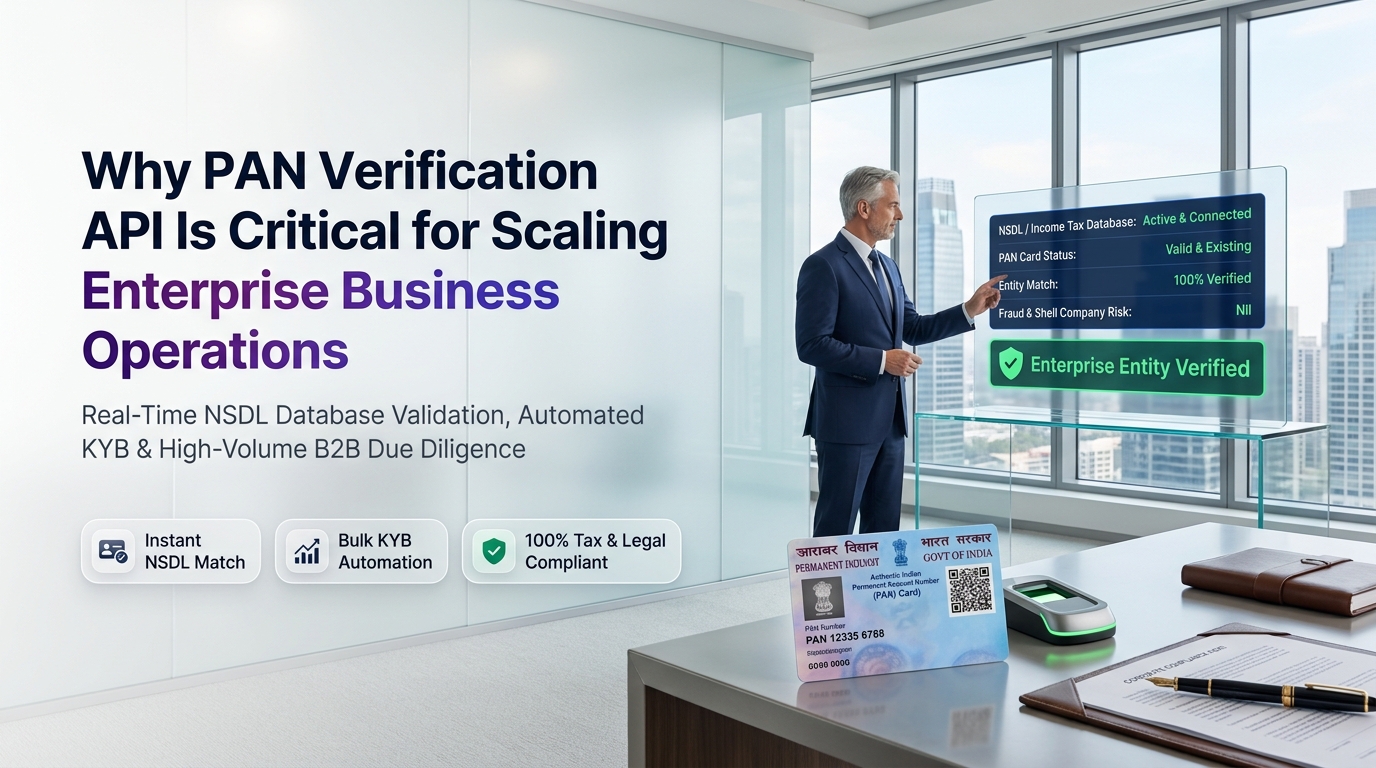
Why PAN Verification API Is Critical for Scaling Enterprise Business Operations
A finance controller in Gurugram once told me her company's vendor master file had been lying to them, and the discovery cost eleven crores in blocked tax credits before anyone understood what was happening.
I was brought in for their vendor onboarding, so I saw the file myself. Thirty-two thousand vendor records, built over a decade of acquisitions and regional offices doing their own thing. The PAN field was filled for nearly all. That was the problem, actually. It looked complete. Nobody had checked whether what was in the field was true.
We ran a sample of two thousand records through a PAN Verification API. About one in twelve came back wrong somehow. Typos that turned one company's PAN into another company's PAN. Vendors who had quietly changed legal structure, so the PAN on file belonged to a dissolved entity. A cluster of supposedly independent vendors sharing one PAN. And plain garbage, letters transposed years ago by a data-entry operator long gone.
One in twelve. At thirty-two thousand vendors, that's over two and a half thousand records feeding wrong data into every payment, every tax filing, every compliance report. The eleven crores in blocked credits came mostly from tax deducted against PANs that didn't match the recipient. The money wasn't lost exactly. It was stuck, which for working capital purposes is the same thing.
Why this only hurts at scale
Here's the thing I try to explain to enterprise teams, and it sounds backwards at first. PAN Verification is not really a fraud tool at enterprise scale. Fraud happens, we caught some in that file, but the bulk of the damage is ordinary error, multiplied.
A company with two hundred vendors can survive a dirty master file. Someone in accounts knows every vendor personally, mismatches get caught over chai. At thirty-two thousand vendors across four ERP systems, nobody knows anything personally. The file is the truth, and if the file is wrong, every downstream system inherits the error at machine speed.
Payments route on it. Tax deductions file against it. Duplicates slip past procurement because the same entity exists under three spellings.
That's why a PAN Verification API for enterprises is scaling infrastructure, not a compliance checkbox. The difference between a master file you assume and one you know.
We've covered the onboarding-time version in our vendor onboarding post, and the banking angle in our KYC risk post. The enterprise version adds one requirement those don't stress: fix the stock, not just the flow.
Verifying new vendors while thirty thousand old records rot doesn't move the needle.
What the cleanup looked like
The Gurugram company did it in three passes, and their sequence is worth copying.
1. Run the historical sweep
First, the full historical sweep. Every vendor record through the API in overnight batches, results written back with a status flag. Took about two weeks including rework.
This is where an Enterprise PAN Verification API earns its keep, because a rail built for one-at-a-time checks chokes on thirty-two thousand records, and several vendors they evaluated couldn't quote a batch price at all.
2. Triage the mismatches
Second, triage. Clean records, the large majority, got a verified flag and a recheck date.
Mismatches went to a small team with authority to actually fix things, chase current documents, merge duplicates, block payment on dissolved entities until someone explained.
Two explanations became internal fraud cases. The shared-PAN cluster turned out to be one promoter invoicing through four names, which procurement had never seen because the names lived in different regional systems.
3. Fix the flow
Third, the flow. PAN Verification API for business onboarding wired into the vendor creation screen, blocking.
No verified PAN, no vendor code, no exceptions without a named approver.
The controller was blunt:
"The file only stayed clean because we made it impossible to dirty it again."
Results, their numbers, rounded. Most of the eleven crores in blocked credits recovered over the following year. Duplicate vendor payments, long written off as reconciliation noise, dropped visibly.
And month-end close got faster, which nobody predicted, because reconciliation exceptions are where close time goes to die.
PAN verification for business operations turned out to be a working-capital project wearing compliance clothes.
FICCI has published for years on how much Indian enterprise efficiency leaks through broken back-office data. A PAN verification API for enterprise KYC is about the cheapest patch available for one of the biggest leaks.
Picking the rail
Short version, from someone who has sat through too many of these procurements.
Batch first
Ask for throughput on a hundred thousand records, in writing.
The Best PAN Verification API for enterprises treats your historical file as a first-class problem, not an afterthought to per-query pricing.
Match behaviour
Then match behaviour: vendor-file names are messy, abbreviations, old spellings, and you need a rail that returns the registered name for your team to compare, not just yes or no.
Check the audit trail
Then the audit trail, every check logged, exportable, per our API security guide and consent notes.
Any PAN Verification API provider in India selling to enterprises should show all three unprompted.
Test with known problem records
And run my usual test.
Fifty vendor records you already know are problems, buried in two hundred clean ones.
An Enterprise PAN verification solution either surfaces your known bodies or it doesn't.
One afternoon, and you'll know.
Conclusion
The Gurugram file looked complete for ten years.
Complete and wrong are compatible, that's the lesson, and at scale the wrongness compounds quietly until it surfaces as blocked crores and unexplainable duplicates.
A PAN Verification API fixes the flow, cleans the stock, then stands guard on the master file every payment and filing depends on.
Scaling operations means trusting data at volumes no human can check personally. That trust has to come from somewhere.
Better a verification rail than an assumption with eleven crores riding on it.