
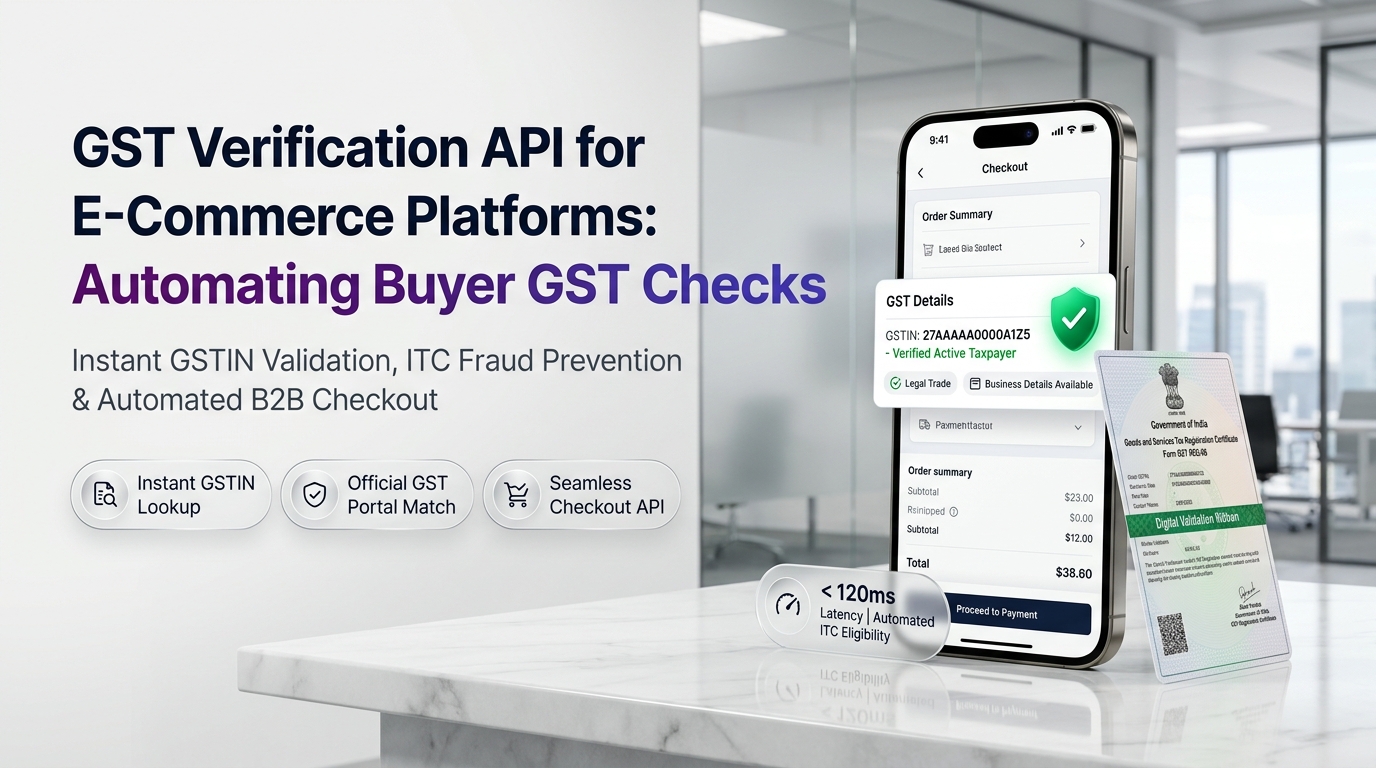
GST Verification API for E-Commerce Platforms: Automating Buyer GST Checks
The finance head of a B2B marketplace once showed me a folder on her desktop named, in all caps, CREDIT NOTE HELL. Inside were four hundred and some invoices from a single quarter, all of them wrong for the same boring reason: business buyers had typed their GSTIN incorrectly at checkout, or typed somebody else's, and the platform had cheerfully printed whatever it was given onto tax invoices.
Every one of those invoices had to be reversed and reissued. Buyers were furious because their input tax credit didn't land. Her team spent, by her estimate, two full working weeks that quarter untangling it. The fix, when it finally came, was almost insultingly simple: a GST Verification API wired into the checkout, validating the number before the order confirmed instead of after the invoice went out. The folder still exists, she told me, but nothing new has gone into it for a year.
That's the whole argument for automating buyer GST checks, and the rest of this post is the detail.
Why buyer GSTINs go wrong so often
On an e-commerce platform, a business buyer adds their GSTIN so the invoice carries it and they can claim input credit on the purchase. Three things go wrong constantly. Honest typos, a 15-character string typed on a phone keyboard is a typo factory. Stale numbers, the buyer's registration got cancelled or moved states and nobody updated the account. And genuine mischief, someone using another firm's GSTIN so their purchases ride on a registration that isn't theirs.
The platform wears all three problems. Wrong GSTIN means reissued invoices and angry buyers at minimum. At worst it means your marketplace is documented as selling to a cancelled registration, which is the kind of thing that surfaces at the least convenient audit.
Here's a detail worth knowing even before any API enters the picture: a GSTIN isn't a random string. Fifteen characters, the first two are the state code, and characters three through twelve are the holder's PAN. Which means the number itself can be sanity-checked for structure instantly, and a GSTIN Verification API then does the real work of checking it against live records.
What a GST Number Verification API returns
A proper GST Number Verification API call takes the GSTIN and returns the record behind it: legal name of the business, trade name, registration status, active, cancelled, suspended, the taxpayer type, state, and registration date. The platform compares the legal name against the buyer's account name and blocks or flags on mismatch, exactly at the moment the buyer can still fix it themselves.
One nuance I flag to every team doing GSTIN Verification for E-Commerce: taxpayer type matters more than people expect. A buyer registered under the composition scheme can't claim input credit at all, so an invoice built for ITC is useless to them either way. A good check surfaces that and saves everyone the confusion. This is what separates thoughtful GST Verification API for E-Commerce implementations from a checkbox: the platform uses the returned fields, not just the green tick.
GST Verification API Pricing
Straight numbers, since vendors are shy about them. GST Verification API Pricing runs per successful call, and market rates in my recent experience sit between one and five rupees depending on monthly volume, response fields, and SLA. A marketplace doing a few thousand checks a month pays the higher end; a platform doing lakhs of checks negotiates hard toward a rupee. Ask the same three contract questions I recommend for every verification service: are not-found lookups billed, what does a retry cost when the upstream is slow, and is there a monthly minimum that quietly doubles your effective rate? That last clause is where the surprises live.
Best GST Verification API: how to actually choose
Teams hunting for the Best GST Verification API tend to compare price lists, but the real differences show up under load. Ask any prospective GST Verification API Provider four things.
Uptime history during GST return-filing weeks, when upstream systems slow and every provider's true engineering shows.
Response states, you want valid, cancelled, suspended, not-found, and service-down as distinct answers, not one boolean.
Data freshness, cancelled registrations should show cancelled within days, not months.
And logging, every check timestamped with a reference ID, because when a dispute arrives eighteen months later that log is your defence.
The plumbing disciplines are the same ones in our API security guide and consent notes, and the sister check most platforms run beside this one is covered in our PAN verification piece. For sector-level context on India's digital commerce growth, NASSCOM publishes regular analysis.
Integration itself is small, a week of developer time to staging in most stacks I've seen. The bigger design decision is user experience: validate at GSTIN entry, show the legal name back to the buyer, "Is this you?", and let them confirm. That one screen kills the typo problem almost entirely.
Conclusion
The CREDIT NOTE HELL folder was never a tax problem, really. It was a data-entry problem the platform had chosen to discover after invoicing instead of before. A GST Verification API for E-Commerce Platforms moves that discovery to the only cheap moment, checkout, where the buyer fixes their own typo in ten seconds. Validate the number, match the name, respect the taxpayer type, log everything. Do that and GST checks fade into what they should be: invisible plumbing that keeps quarters boring, folders empty, and buyers claiming their credit without a single reissued invoice.