
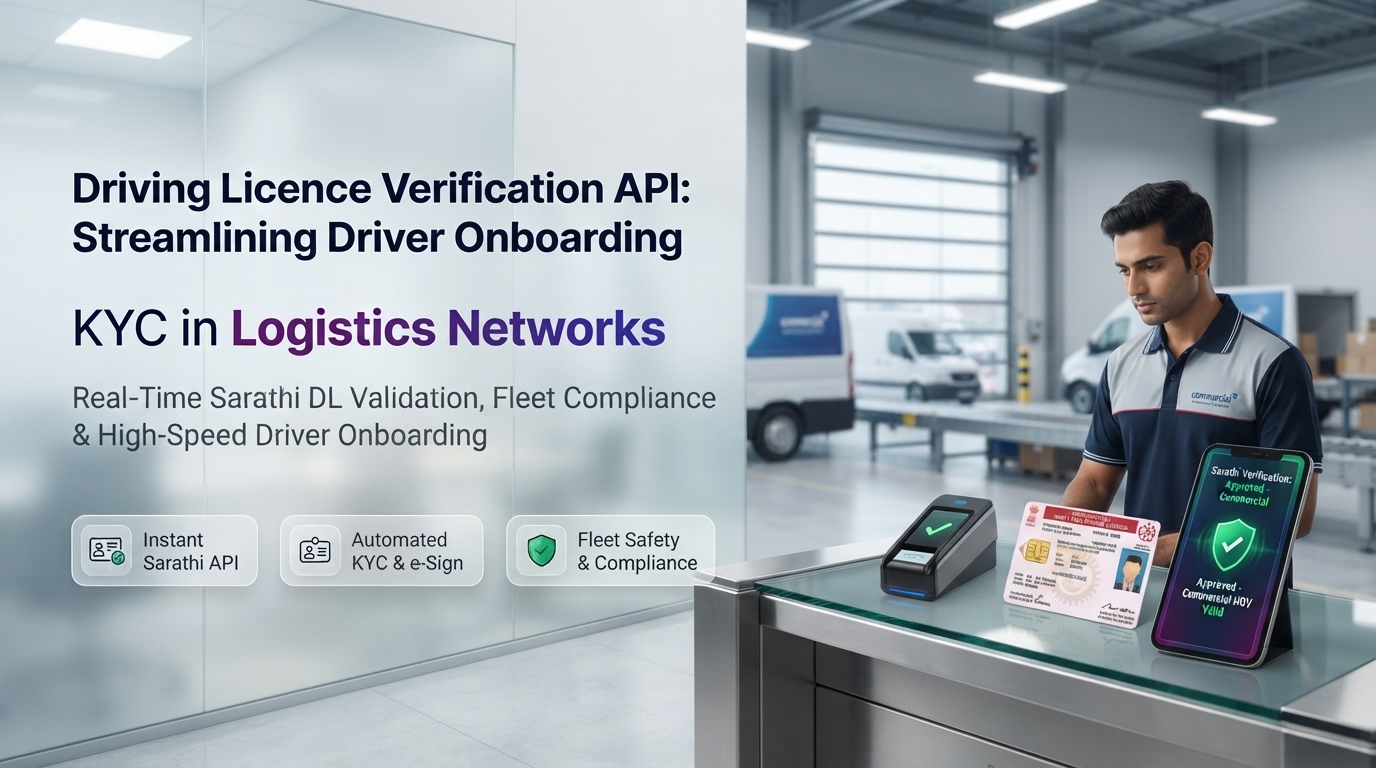
Driving Licence Verification API: Streamlining Driver Onboarding & KYC in Logistics Networks
In 2022 I did some work for a last-mile delivery company that had just been through an ugly insurance claim. The background facts, from their ops manager: one rider ID on their system had eleven months of continuous attendance, no leave, deliveries logged seven days a week. The ID performed so well that someone in ops had floated giving it an award.
During the claim investigation it came out that three men were behind it. Two brothers and a cousin, sharing one account and one uniform. The licence on file was the eldest brother's. The rider in the accident was the youngest, who did not have a licence at all.
The company had collected a licence photocopy at onboarding, filed it, and never looked at it again. That was the entire verification process. The claim got contested, a client contract came under review, the ops manager spent a month writing explanations.
Then they changed the process, which is the part worth writing down.
What the Hub Supervisor Cannot Do
The old process failed for a specific, boring reason. Onboarding happened at hubs, places like Bhiwandi and Sonipat, where a supervisor might face forty applicants in a morning during hiring season.
For each applicant he had about a minute with the licence, and in that minute he was supposed to establish four things:
- Whether the card was genuine.
- Whether it was still valid.
- Whether it belonged to the person handing it over.
- Whether it covered the vehicle class the job needed.
Forty times in a morning, with a target on the wall.
That check cannot be done reliably under those conditions, so in practice it wasn't done. It was replaced by photocopying. The file looked complete, and the three-brothers ID sat inside a complete-looking file for eleven months.
A driving licence verification API moves the check from the supervisor's eyes to the issuing record. The licence number is submitted, with the applicant's consent, and the response comes back in seconds with the holder's name, validity dates, and vehicle classes covered.
The system compares the name against the applicant. The supervisor's job reduces to confirming the person in front of him matches the person the record describes, which a human can actually do forty times in a morning.
Three Failure Types That Matter
Three failure types matter, with different costs.
An expired or fake licence means an uninsured vehicle running in company livery.
A licence belonging to someone else is the three-brothers case.
A wrong vehicle class, a two-wheeler licence holder assigned to a light commercial van, is a liability that surfaces at claim time.
Our mobility platform post goes through the equivalent checks for ride-hailing. The logistics difference is commercial vehicle classes and much higher onboarding volume.
What Changed at One Network
The company integrated a driver verification API the quarter after the claim. Their numbers, twelve months later, rounded.
Onboarding time went from two or three days to under twenty minutes. The old duration was the paper loop: photocopy couriered to a central office, reviewed, queried, returned.
With driving licence verification for fleet drivers running at the hub, the applicant is verified before he leaves the building.
The following festival quarter, the network onboarded around eleven thousand riders with checks running the same as off season. Previously, peak volume had meant checks were quietly dropped, never recorded as a decision, just what happened under load.
The failure rate ran at about one in eighteen applicants. Expired licences were the largest category, wrong vehicle class second, and a small steady number of licences that did not match the applicant.
Identity-related insurance disputes had been running at roughly one per quarter. In the year after integration there were none. The claims team registered the change before anyone else did.
Contractor Verification
Contractor hiring was the weakest area, and the fix was contractual rather than technical.
Contractors got the same verification flow through a driver KYC API for logistics, and their payment terms were amended to require its use. Per-contractor logs made compliance checkable.
Exits improved as a side effect: with entry identity verified, deactivating access and settling deposits stopped producing disputes about who was who.
Consent handling applies throughout, these are workers' credentials, our consent notes cover the requirements, and the logging practices in the API security guide make the trail usable in a client audit.
Choosing One for a Network
Evaluation criteria for a driving licence verification API for logistics, based on what broke or held in deployments I've seen.
1. Test the Real Load Shape
Forty applicants at nine a.m. across two hundred hubs is a spike, not a query, and a driving licence verification API provider in India should be asked for latency figures under that pattern.
2. Check Format Coverage
Applicants bring licences from every state and decade, and the best driving licence verification API for logistics is the one that parses a 1996 small-town licence, since those are exactly the ones a queue-pressed supervisor waves through.
3. Make Vehicle Class Structured
Vehicle class must come back as structured data, because the assignment system, not a person, consumes it.
4. Plan for Connectivity Failures
Connectivity failure handling matters. Hubs drop offline regularly.
5. Keep Contractor Activity Auditable
Contractor sub-accounts with separate logs make franchise-heavy networks auditable, the relevant feature for any driver verification API for logistics companies.
For context, FICCI has documented the pace at which organised logistics in India is scaling; the compliance load scales with it, and the manual version of these checks does not.
Conclusion
The three brothers were sharing a job, not running a racket, and the company's exposure came entirely from onboarding that could not tell one man from three.
A driving licence API for driver onboarding fixes that at the cheapest possible point, the day of joining.
A driving licence API confirms the licence, the person, and the vehicle class in the time it takes to fill the rest of the form, and leaves a log that stands up in a claim.
The network now treats verification as part of the hiring queue rather than an obstacle to it. Eleven thousand peak-season hires later, that position looks correct.