
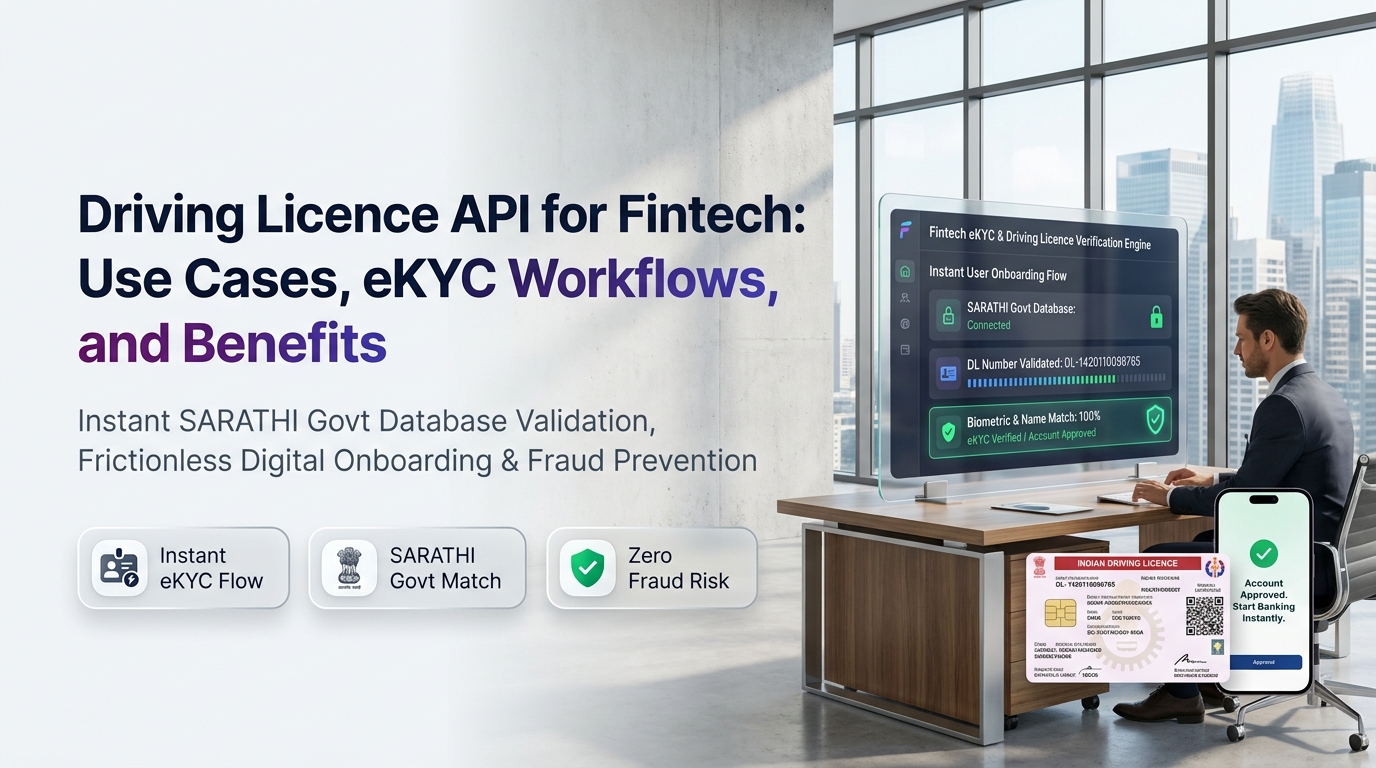
Driving Licence API for Fintech: Use Cases, eKYC Workflows, and Benefits
vehicle insurance insights
A product head at a consumer-lending app told me something last year that rearranged how I think about KYC drop-offs. Her team had been obsessing over their onboarding funnel, the usual autopsy, which screen loses people, and the numbers said the biggest leak wasn't the selfie step or the bank-linking step. It was the document step, and specifically the users who didn't have their PAN card within arm's reach at that moment.
Think about who applies for a small personal loan at 9pm. Someone on a bus. Someone in a kitchen. Someone whose PAN is in a drawer in another city at their parents' house. Her line, which I've repeated in a dozen product meetings since: "We were losing customers not because they failed verification, but because they couldn't find a card."
The fix her team shipped was almost embarrassingly simple: accept the document people actually carry. The driving licence lives in wallets, not drawers. They wired in a driving licence API, let users pick licence or PAN at the document step, and the document-step drop-off fell by a third in the first month. Not from better marketing or a prettier screen. From accepting the card that was already in the room.
What the API actually does
The plumbing is straightforward to describe. With the user's consent, a driving license verification API takes the licence number and date of birth, checks them against the issuing records, and returns the verified details: holder name, licence status, validity dates, vehicle classes covered. Your system matches the name and date of birth against the application, checks the status is active, and moves on. Two or three seconds, all in the background, while the user is still looking at the progress bar.
What it replaces is the part fintech people forget was ever manual: a human looking at an uploaded photo of a card, squinting at whether the hologram looks plausible, typing the details into a system. That process was slow, error-prone, and, honestly, theatre. Licence formats vary so much across states and issue years that visual inspection was never a real control, a point our legal-industry post makes from a law firm's chair. Checking against the record is the control. Everything else was ritual.
Where fintechs actually use it
Driving licence verification for fintech shows up in more corners than people expect, and each has its own logic.
Lending onboarding is the volume case, the 9pm bus applicant. A driving licence API for eKYC gives users a second document path, and every additional valid path recovers real customers at the margin. The product head's team measured it properly: the licence path converted better than PAN for users under thirty, which surprised everyone until someone pointed out that younger users carry licences and memorise nothing.
Vehicle-secured lending doubles the value, because the same document does two jobs: identity at the front, and driving eligibility when the collateral is a vehicle someone intends to drive. Pairing it with the RC check covers person and machine in one flow.
Insurance is quieter but bigger. Motor-insurance products verify the proposer's licence at issuance, since a policy sold to an unlicensed or suspended driver is a claims dispute waiting patiently. And gig-economy platforms, the original heavy users, run the check at driver onboarding, which our mobility post covers from that industry's seat.
One pattern across all of them, the same one this whole series keeps finding: the check surfaces facts, a person handles the exceptions. An expired licence at loan onboarding isn't fraud, it's usually a renewal someone forgot. Route it to a human, don't auto-reject the customer.
The eKYC workflow, done properly
A driving licence eKYC API integration lives or dies on details that never make the sales deck. Consent first, captured and logged before the call, the non-negotiable from our consent notes. Distinct response states, valid, expired, suspended, not found, name mismatch, because each routes differently and a bare pass-fail forces your product team to guess. Fuzzy name matching with a threshold, licence records and application forms disagree about names constantly and innocently, initials, spellings, the same lessons the penny drop post covers for bank accounts. And logging: timestamp, reference ID, stored response, per the API security guide, because eighteen months from now an audit will ask exactly what you knew at onboarding.
Latency deserves its own sentence. The user is inside your funnel while this runs. A driving licence verification API for fintech that answers in two seconds is a feature; one that answers in thirty is a drop-off statistic.
On selection, the best driving licence verification API for your stack comes down to the familiar questions: uptime during your peak hours, honest pricing clauses, per-call rates that survive your actual volume, and support that answers on a Friday evening. Any driving licence API provider in India worth shortlisting will also handle the state-format variations cleanly, ask them specifically about older licence numbers, because your users' documents span thirty years of issuing history. Sector context on digital onboarding growth sits with NASSCOM, which has tracked the eKYC infrastructure boom for years.
Conclusion
The product head's funnel chart is the whole argument compressed: her biggest KYC leak wasn't fraud or failure, it was a card in a drawer in another city. A driving licence API fixes exactly that, verification against the document people actually carry, checked at the source in seconds, with consent and logs as by-products.
Give users the licence path, match names with sensible fuzziness, route exceptions to humans, and watch the document-step drop-off shrink. In fintech onboarding, the best verification is the kind the honest customer never notices, and the licence in their wallet is the shortest road there.