
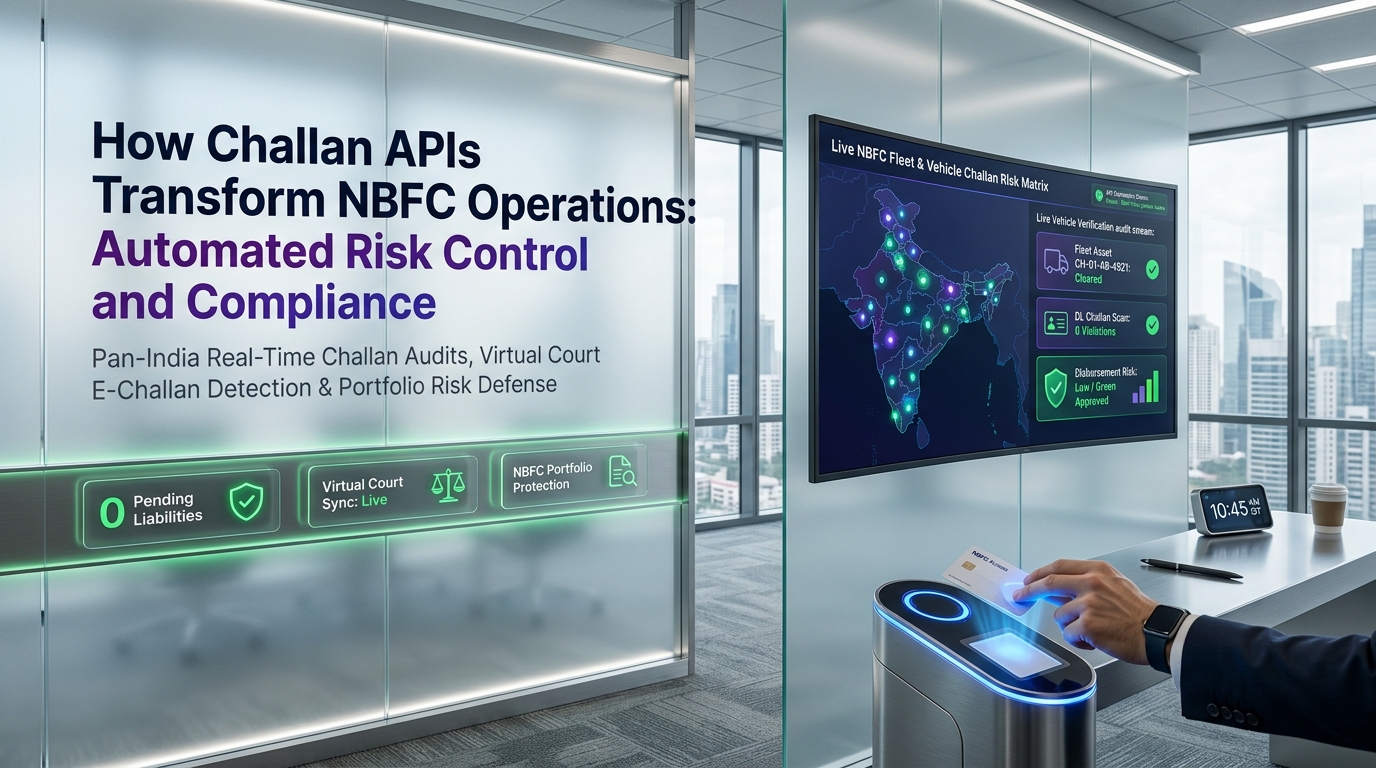
How Challan APIs Transform NBFC Operations: Automated Risk Control and Compliance
"Sir, the ones who default, they get fines first."
That sentence came from a collections head at a vehicle-finance NBFC in Gujarat, in the middle of a quarterly review I was sitting in on, and she said it almost apologetically, the way people do when they're about to contradict a slide full of credit models. The risk head stopped talking. Somebody asked her to repeat it.
She'd been keeping her own notes, is the thing. Not a model, a hunch in a spreadsheet. Accounts that went bad, she'd noticed, tended to collect traffic challans in the months before the first bounce. A truck picks up four overloading fines in one month, and next quarter, two EMIs fail. Her field officers had a joke about it. Nobody upstairs had ever heard the joke, because fines didn't exist in any system the company ran. Not in the LMS, not in the credit file, nowhere.
I want to be honest about my own reaction: I thought it was a curiosity. Interesting pattern, probably confounded, file it away. The company thought otherwise, and the company was right. Twelve months on, every vehicle in their portfolio gets checked automatically through Challan APIS plugged into the loan system, and the collections head's hunch has become a control with a budget line.
What NBFCs were missing
Think about what an NBFC actually knows after disbursal, versus what it knew before.
Before: everything. Borrower's income, credit history, references. Vehicle's ownership, hypothecation, valuation, the whole layer from the NBFC collateral post. A thick file.
After: one number a month. Did the EMI come or not.
Meanwhile the collateral is out there living a life. Crossing state lines, taking loads it shouldn't, getting driven by whoever the borrower hired last week. Each violation becomes a dated, located record against the registration number, and none of it reaches the lender. Pending fines stack up and quietly eat recovery value, there's a sixty-three-challan horror story about that in the banking post. Violation patterns bend when the borrower's business bends. New routes. New drivers. New desperation. All of it visible, none of it plumbed.
A challan API for NBFCs is only that: the missing pipe. Nothing clever happens inside the pipe. The cleverness is deciding to lay it.
Challan API for NBFC operations, in practice
What the Gujarat company built, in the order they built it.
Origination first, because that's where the money leaks fastest. A vehicle challan verification API for NBFCs now runs on every file next to the ownership check. They picked five thousand rupees as the threshold after some arguing, above it, the seller clears the fines before disbursal or the amount comes off the loan. Below it, noted, ignored. First quarter of running this: pending fines on roughly one file in nine. Nobody had predicted a number that high. I checked it twice.
Then the live book. Quarterly batch runs, a few thousand registration numbers at a go. One rule sits on the output: violation count jumps materially quarter over quarter, flag to collections. Not to legal. To collections, as a conversation. The collections head, same woman, tells me the flag usually becomes a phone call that opens with "how's business," and that these calls have turned into their best early-warning channel, because a borrower under stress will talk to someone who rings before the bounce. After the bounce, everyone's a lawyer.
Last, repossession. One final check before any auction listing, so pending fines land in the reserve price instead of arriving as a surprise deduction at settlement. Her recovery team named it the "no surprises run," and the name stuck company-wide, which tells you it was needed.
Headcount added for all this: zero. Automated challan verification for NBFCs means the API returns structured fields, count, amounts, dates, status, and rules route everything. People touch only the contradictions.
The compliance layer
Here's the part nobody at that quarterly meeting foresaw, and it might be the most durable benefit. When the statutory auditors came around asking how collateral risk was monitored after disbursal, historically a question answered with shuffling and emails, the company generated a report in minutes. Every check logged, timestamped, reference ID, stored response. A challan API for compliance purposes is mostly this: not the checking, the proving you checked. The API security guide discipline, consent, access control, retention, applied to one more data stream. Supervisory expectations on NBFCs have been tightening for years, the FIDC has documented that direction steadily, and systematic collateral surveillance is drifting from impressive toward expected.
If you're shopping for the best challan verification API for NBFC compliance, I'd interrogate four things and skip the brochure: multi-state coverage, since commercial fleets earn across borders and their fines chase them; batch capacity sized to your actual book; distinct response states, never a bare pass-fail; and log exports an auditor can consume without a follow-up meeting. Everything else is negotiable. Those four aren't.
Conclusion
The joke in the field team turned out to be a working risk model, and I keep thinking about how close it came to staying a joke. The signal was there for years. Fines first, bounces later. It cost nothing to know and nobody knew it, because no pipe existed between the enforcement record and the loan system. Now the pipe costs a few rupees per check, finds money on one file in nine at origination, warns collections before the bounce, and answers auditors in minutes. If you run a vehicle book, the odds are good your own field officers already have the joke. The Challan API is just what it looks like when management finally laughs.