
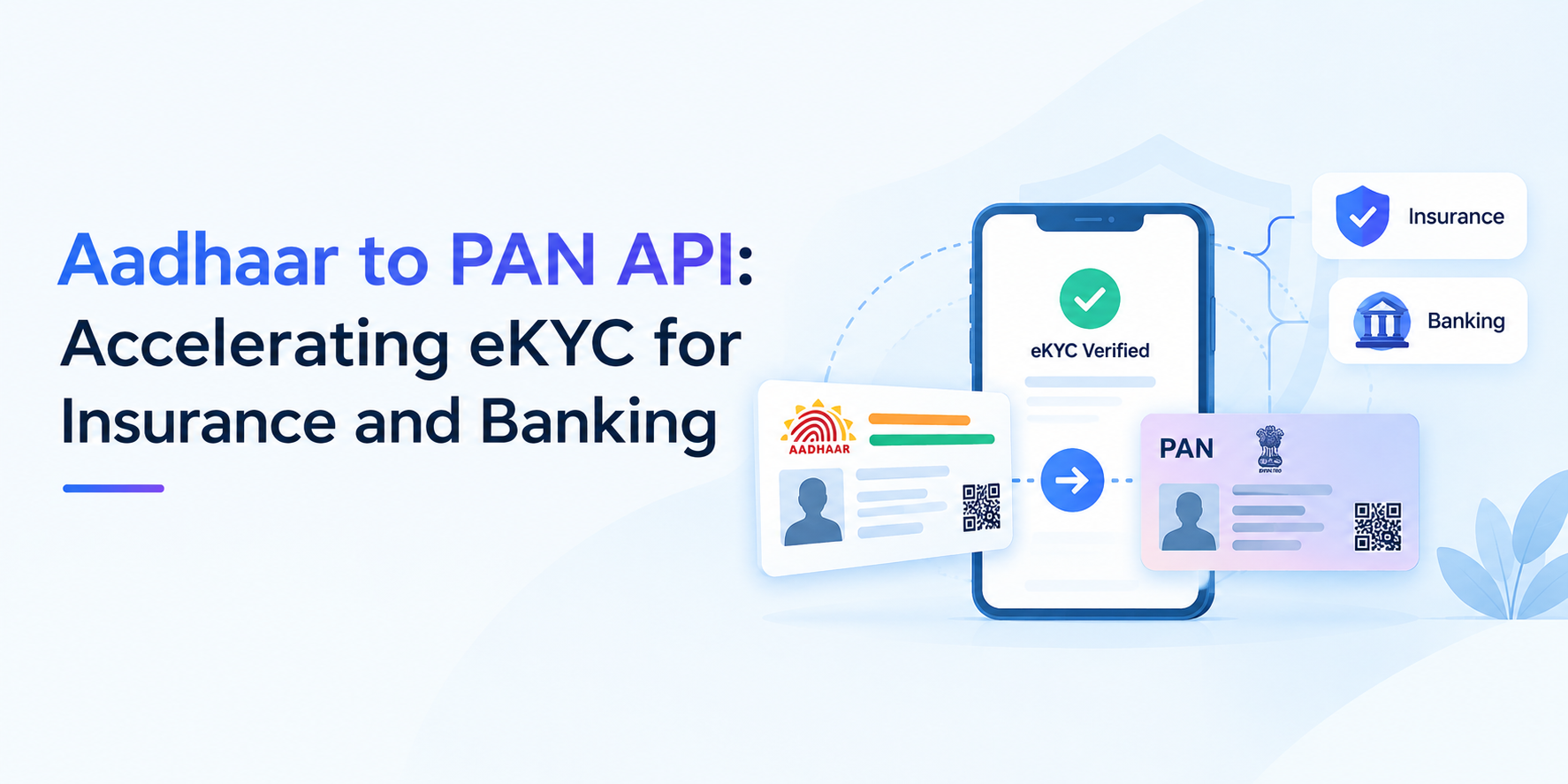
Aadhaar to PAN API: Accelerating eKYC for Insurance and Banking
A few years ago I spent an afternoon in the back office of a midsized insurer. There were maybe twenty people at desks, and most of them were doing the same job: open a scanned proposal form, look at a PAN card, squint at the name, and check whether it matched what the applicant had typed into the website. One woman told me she rejected maybe forty files a day and approved the rest, and she was never quite sure she got either decision right. She also said the job was boring enough that her eyes started glazing over by lunch.
That room is the problem. Customers feel it at the front end as repeat uploads, three-day waits, and the familiar annoyance of being told their name "doesn't match." Companies feel it at the back end as slow turnaround, manual error, and audit files nobody wants to defend. Applications arrive from every channel a business runs, branches, apps, websites, agents, partners, and somebody still has to eyeball most of them.
An Aadhaar to PAN API is, at heart, a way to make that room smaller. Used properly, it folds identity and PAN checks into one digital workflow so customers move faster, without quietly ditching consent, privacy, or the rules.
What Is an Aadhaar to PAN API?
Let me start with what it is not, because this misunderstanding is surprisingly common even among people buying the software. You cannot type an Aadhaar number into an Aadhaar to PAN API and get a PAN out. Aadhaar verification and PAN validation are different services, with different permissions sitting behind each. If a vendor demos unrestricted Aadhaar-to-PAN lookups, thank them for their time and move on.
What an Aadhaar PAN verification API actually does is connect authorised checks to your onboarding system, so verification happens inside the flow rather than in a spreadsheet next to it. Depending on who the provider is and what your use case is approved for, it can help a business:
- Launch an Aadhaar-based verification, consent captured first
- Validate PAN information through an authorised channel
- Compare the fields comparison is actually permitted for, mainly name and date of birth
- Log the consent artefact and the transaction reference
- Push anything mismatched to a human instead of killing the file
Here is a practical point teams learn the hard way. An Aadhaar based eKYC API that only answers "success" or "fail" is half a product. You want states: verified, mismatch, invalid details, technical error, review required. Your ops person working a Saturday morning queue needs to know which of those they are looking at, or the ticket gets bounced around for hours.
How the Verification Process Usually Works
The typical flow is not complicated to describe:
- The customer enters personal and financial details.
- The screen explains what will be verified, and why, before anything runs.
- Consent is captured through the permitted method.
- The Aadhaar-based identity check completes.
- PAN is validated through its own, separate channel.
- The system compares both responses against the application form.
- Clean matches carry on automatically.
- Exceptions land with a trained reviewer.
Step eight is where I'd push back on a lot of product demos. People building these systems love the auto-reject. It feels decisive. But look at mismatch data from almost any portfolio and the same picture shows up: the bulk of mismatches are ordinary human messiness, not fraud. One record says initials ("K. S. Reddy"), the other says a full name ("Kavitha Srinivas Reddy"). A birth year has two digits swapped. A woman updated her surname after marriage on PAN but not on the other document. None of that is criminal. All of it gets rejected by a rigid system, and the business simply loses honest customers who never come back to reapply. Review costs minutes. Rejecting costs the customer.
Example: A Digital Insurance Application
Say someone is buying a health policy on an insurer's website late one evening. They fill in name, date of birth, address, PAN. Before the verification fires, the screen tells them plainly what the Aadhaar-based step does and asks for consent. No consent, nothing happens.
The eKYC API for insurance sends the permitted request via the chosen provider. A response comes back, and the system compares it against the proposal form, field by field.
Match? The file rolls into underwriting. Small name difference, middle name expanded, an initial written out? The system can ask for one quick confirmation rather than slamming the door.
One caveat worth saying out loud, because sales material tends to blur it: identity verification supports underwriting. It does not do underwriting. Medical tests, nominee checks, fraud screening, the underwriter's actual judgement, those still happen. The API removes the grunt work so the humans can spend attention where attention changes outcomes.
Use Cases in Banking
Banking throws up more entry points than insurance. An eKYC API for banking commonly backs digital savings accounts, personal loans, credit cards, current accounts, and periodic customer updates.
Most banks run the two checks in parallel. There is an Aadhaar verification API for the approved identity step, and a separate PAN card verification API for the PAN the customer entered. What the bank then does, approve, pause, or escalate, is governed by the bank's own internal policy. It should not be governed by whatever the vendor decided was a good default.
The bit people underrate is the paper trail. For every case, a good setup keeps hold of the consent reference, the timestamp of the request, the transaction ID, the exact result returned, and the action the bank took. That list sounds dull until a compliance officer asks about a check from five months ago, or a customer calls asking why their account got stuck. Then it's the difference between a five-minute lookup and a two-day email chase.
Privacy Should Be Built into the Workflow
Aadhaar and PAN are not like other form fields. Leaked contact details are a nuisance. Leaked identity data can wreck someone's financial life for years, which means privacy cannot be a phase-two add-on. It has to be designed in from the first wireframe.
For the customer, the requirement is simple to state: they should know what is being checked, why, and what happens to the result. Consent buried somewhere in a wall of terms and conditions doesn't genuinely meet that bar, even if a lawyer has signed off on the wording.
Internally, most people in an onboarding chain have no business seeing a full identity number on screen. Mask it. Encrypt it at rest and in transit. Tokenise where feasible, gate access by role, and set retention limits so logs aren't sitting around forever.
Before contracting a provider, get real answers on where consent records live, where the request is actually processed, what the encryption looks like, how long logs are kept, whether deletion and access controls are supported, and, honestly, what your team is supposed to do at 11 a.m. on a working day when the provider goes down.
Businesses should read the UIDAI legal framework before building anything Aadhaar-related, and treat any service promising unrestricted Aadhaar-to-PAN lookups with the same suspicion as an unsolicited mail selling a "guaranteed verified lead list."
For PAN-side questions, the official Income Tax Department e-Filing portal remains the source of truth.
Questions to Ask Before Choosing a Provider
Price matters, sure, but it's the easiest figure in the deck to compare and the worst reason to pick someone. Ask instead:
- Where does the data actually come from, and is it authoritative?
- Is the service authorised for our use case, in writing?
- Are response codes documented, specific, and stable across versions?
- Can we retrieve consent and transaction records months later, quickly?
- What do response times look like under month-end and festival-campaign load?
- Is there a genuine manual-review path, or does mismatch just mean "failed"?
- What uptime and support commitments are written into the contract, not the brochure?
- Do we get full documentation and test credentials well before go-live?
Two of these topics get a deeper treatment in our guides on consent management for eKYC and API security for financial services, which your product and compliance folks should probably skim together.
Final Thoughts
Aadhaar to PAN verification can genuinely take a sledgehammer to onboarding friction. The repeat scans, the retyping, the three-day wait over a single letter in a name, much of that just stops happening. What it cannot do is excuse anyone from consent, authorisation, or the law around identity data.
The Aadhaar to PAN API pays for itself when three things hold at once: checks run through properly approved channels, the decision rules are written and understood by your own team, and a human queue catches the cases no automation should decide alone. Easy applications sail through. Odd ones get a fair look.
That balance is the whole job, really. Customers notice speed on day one. Regulators, auditors, and the people whose data you hold notice the other stuff, accurate verification, responsible handling, an audit trail that holds up, years later. That's what keeps a fast onboarding flow trustworthy instead of merely fast.